
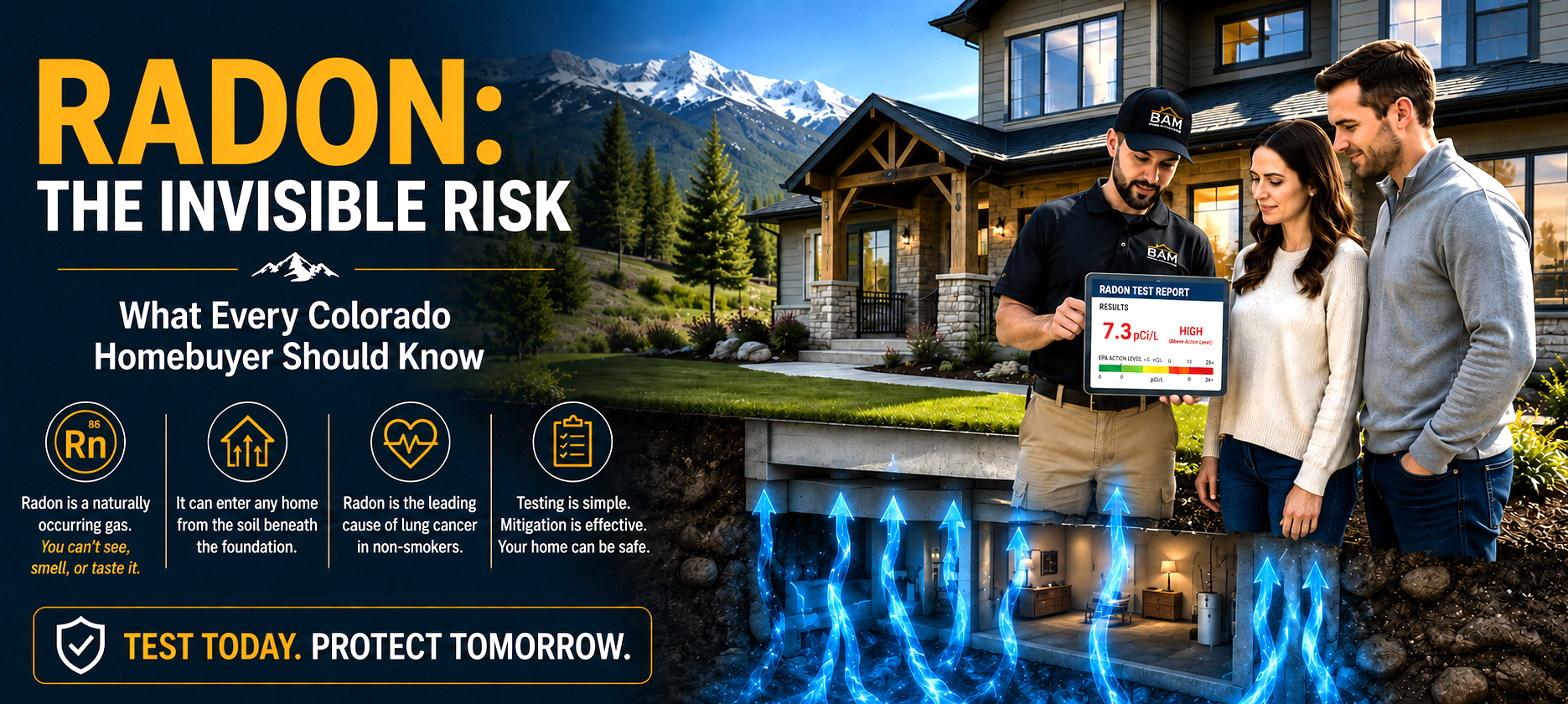
The Invisible Risk You Can't See, Smell, or Taste
Imagine purchasing your dream home.
The roof looks great.
The plumbing works perfectly.
The electrical system checks out.
Everything appears to be in excellent condition.
Yet one of the most significant health risks in the home can’t be seen, smelled, or tasted.
And Colorado has some of the highest radon levels in the nation.
The good news?
Testing for radon is simple, affordable, and can provide valuable information about the home you’re considering purchasing.
If you’re buying a home in Colorado, here’s what you should know.
One of the most significant health risks in the home can't be seen, smelled, or tasted. It's called radon. [Radon: The Invisible Risk]
BAM Home Inspections Share to X
What Is Radon?
Myth:
“Only older homes have radon.”
Reality
“Homes of any age can have elevated radon levels.”
Radon is a naturally occurring radioactive gas that forms as uranium in the soil breaks down over time.
It rises from the ground and can enter homes through:
- Foundation cracks
- Utility penetrations
- Expansion joints
- Crawlspaces
- Sump pits
- Other openings in contact with the soil
Because radon is:
- Colorless
- Odorless
- Tasteless
There is no way to detect it without testing.
A home can look absolutely perfect and still have elevated radon levels.
Why Is Radon a Bigger Concern in Colorado?
Colorado’s geology makes radon more common than in many other parts of the country.
In fact, Colorado is consistently ranked among the states with the highest percentage of homes testing above the Environmental Protection Agency’s (EPA) recommended action level.
Many Colorado communities have reported elevated radon levels, including:
- Colorado Springs
- Monument
- Castle Rock
- Parker
- Denver
- Highlands Ranch
- Pueblo
- Woodland Park
The reality is simple:
Elevated radon levels can occur almost anywhere in Colorado. (You can check average radon levels in your area at Radalink.)
That’s why testing is so important.
In fact, Colorado is consistently ranked among the states with the highest percentage of homes testing above the Environmental Protection Agency's recommended action level. [Radon: The Invisible Risk]
BAM Home Inspections Share to X
Why Your Neighbor's Radon Test Doesn't Matter
"My neighbor tested low, so my house should be fine." Unfortunately, radon doesn't work that way. [Radon: The Invisible Risk]
BAM Home Inspections Share to X
Myth:
“My neighbor tested low, so my home is fine.”
Reality:
“Radon levels can vary significantly between neighboring homes.”
One of the most common misconceptions about radon is:
“My neighbor tested low, so my house should be fine.”
Unfortunately, radon doesn’t work that way.
Two homes on the same street can have dramatically different radon levels.
In some cases:
- One home may test well below recommended levels.
- The home next door may test significantly higher.
Differences in…
- Foundation construction
- Soil conditions
- Ventilation
- Air pressure
- Building design
…can all influence radon levels.
The only way to know the radon level in a specific home is to test that specific home.
Can New Homes Have Elevated Radon Levels?
Absolutely.
Many buyers assume:
“It’s a brand-new home. Surely it doesn’t have radon.”
Unfortunately, new construction is not immune.
Radon comes from the soil beneath the home—not from the age of the structure.
In fact, newer homes are often built to be more energy efficient and tightly sealed, which can sometimes increase the potential for radon accumulation.
Whether a home is…
- Brand new
- Ten years old
- Fifty years old
…testing is still recommended.
Newer homes are often built to be more energy efficient and tightly sealed, which can sometimes increase the potential for radon accumulation. [Radon: The Invisible Risk]
BAM Home Inspections Share to X
What Happens If the Radon Level Is Elevated?
Myth:
“If I don’t use my basement, radon isn’t a concern.”
Reality:
“Radon can move throughout the home and affect living areas above the basement.”
Many buyers become concerned when they hear the words:
“The radon level is elevated.”
But elevated radon levels don’t necessarily mean you should walk away from the home.
In most cases, the issue can be addressed through a radon mitigation system.
A mitigation system typically:
- Reduces radon levels significantly
- Operates continuously
- Requires very little maintenance
- Is installed by a qualified mitigation contractor
Modern radon mitigation systems are highly effective and have helped countless homeowners reduce radon levels well below recommended limits.
Should Buyers Walk Away From a Home With High Radon?
In most situations, the answer is no.
Unlike foundation failure, major structural damage, or severe water intrusion, elevated radon levels are often very manageable.
Many buyers successfully negotiate:
- Mitigation system installation
- Seller credits
- Other solutions prior to closing
The important thing is knowing the radon level before purchasing the home.
Testing provides information.
Information leads to informed decisions.
Myth:
“A home with elevated radon is a bad investment.”
Reality:
“Most elevated radon levels can be effectively reduced through mitigation.”
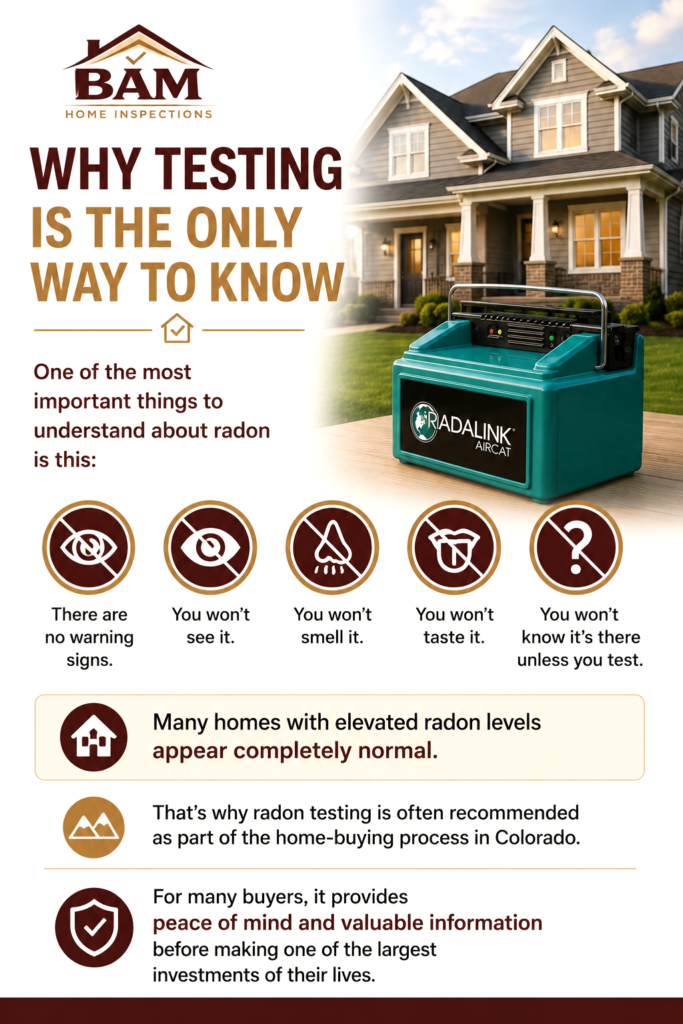
Why Testing Is the Only Way to Know
One of the most important things to understand about radon is this:
There are no warning signs.
You won’t see it.
You won’t smell it.
You won’t taste it.
You won’t know it’s there unless you test.
Many homes with elevated radon levels appear completely normal.
That’s why radon testing is often recommended as part of the home-buying process in Colorado.
For many buyers, it provides peace of mind and valuable information before making one of the largest investments of their lives.
Many homes with elevated radon levels appear completely normal. That's why radon testing is often recommended as part of the home-buying process in Colorado. [Radon: The Invisible Risk]
BAM Home Inspections Share to X
Final Thoughts
When buying a home in Colorado, there are many things to consider:
The roof.
The plumbing.
The electrical system.
The foundation.
But one of the most important things you may never see is radon.
Because radon is invisible, testing is the only way to know whether elevated levels are present.
Fortunately, testing is simple.
The results are valuable.
And if elevated levels are discovered, effective solutions are often available.
A radon test doesn’t tell you whether to buy a home.
It helps you better understand the home you’re buying.
And when it comes to making one of the largest investments of your life, knowledge is a powerful thing.
Colorado Homebuyer Tip
Don’t assume. Don’t guess.
Test.
Because when it comes to radon, the only way to know is to measure.
Frequently Asked Questions (FAQs)
The Environmental Protection Agency (EPA) recommends taking action when radon levels reach or exceed 4.0 pCi/L.
Most real estate radon tests are conducted over a period of approximately 48 hours.
Compared to the cost of purchasing a home, radon testing is typically a relatively small investment that can provide valuable information.
Yes. Radon levels can fluctuate due to weather conditions, seasonal changes, ventilation, and other factors.
Yes. Periodic testing helps confirm that the mitigation system continues to perform effectively.
Yes. Elevated radon levels can occur in homes throughout Colorado, regardless of location, age, or price range. Because radon is invisible, odorless, and tasteless, testing is the only way to determine whether elevated levels are present. Many experts recommend radon testing as part of the home-buying process.
Absolutely. Radon originates from the soil beneath the home—not the age of the structure. In fact, newer homes are often built to be more energy efficient and tightly sealed, which can sometimes contribute to radon accumulation. Whether a home is new or old, testing is still recommended.
No. Radon levels can vary significantly from one home to another, even if they are located next door to each other. Differences in foundation design, soil conditions, ventilation, and construction methods can all affect radon levels. The only way to know the radon level in a specific home is to test that specific home.
In most cases, no. Elevated radon levels are often manageable through the installation of a radon mitigation system. Many buyers successfully negotiate mitigation system installation, seller concessions, or other solutions before closing. The important thing is identifying the issue before purchasing the home so informed decisions can be made.
Radon levels can change over time due to seasonal conditions, weather patterns, ventilation changes, and modifications to the home. Even homes with mitigation systems should be tested periodically to confirm the system continues to operate effectively and maintain reduced radon levels.
Unfortunately, there are no signs. Radon has no color, odor, or taste, and it does not cause visible symptoms in a home. A property with elevated radon levels may appear completely normal. That’s why testing is so important—it’s the only reliable way to determine whether elevated levels are present.