
A Home Buyer's Guide to a Better Inspection Experience
For many buyers, inspection day is one of the most anticipated—and sometimes intimidating—moments in the home-buying process.
Questions begin to swirl:
- What if the inspector finds something major?
- Should I be worried?
- How long will this take?
- What am I supposed to do during the inspection?
- What if the house isn’t perfect?
If you’re feeling a little nervous, you’re not alone.
The good news is that inspection day doesn’t have to be stressful. In fact, many buyers leave feeling more informed, more confident, and more excited about their future home.
Understanding what to expect can help you get the most out of the experience.
If you're feeling a little nervous, you're not alone. The good news is that inspection day doesn't have to be stressful. In fact, many buyers leave feeling more informed, more confident, and more excited about their future home. [What to Expect on Inspection Day]
BAM Home Inspections Share to X
Expect the Inspection to Take Several Hours
A professional home inspection is a thorough evaluation of the home’s major systems and components.
Depending on the size, age, and condition of the property, most inspections take anywhere from two to four hours, and sometimes longer.
While that may seem like a lot of time, remember that your inspector is evaluating dozens of components throughout the home, including the roof, structure, electrical system, plumbing system, heating and cooling equipment, attic, crawlspace, and much more.
A quality inspection isn’t rushed.
Thoroughness takes time.
Most inspections take anywhere from two to four hours, and sometimes longer. While that may seem like a lot of time, remember that your inspector is evaluating dozens of components throughout the home. [What to Expect on Inspection Day]
BAM Home Inspections Share to X
Expect Your Inspector to Be Thorough
Many first-time buyers are surprised by just how much ground an inspector covers.
While you’re looking around the kitchen or admiring the backyard, your inspector may be:
- Walking the roof
- Crawling through the attic
- Testing electrical outlets
- Evaluating plumbing fixtures
- Examining the furnace
- Looking for signs of moisture intrusion
- Inspecting the foundation
A quality inspector is constantly gathering information, documenting observations, taking photographs, and evaluating the home’s condition.
Think of the inspection as a puzzle.
Your inspector is putting together dozens of pieces to create a clearer picture of the home as a whole.
A quality inspector is constantly gathering information, documenting observations, taking photographs, and evaluating the home's condition. Think of the inspection as a puzzle. [What to Expect on Inspection Day]
BAM Home Inspections Share to X
Expect to See Some Findings
This is perhaps the most important thing buyers should understand before arriving on inspection day:
Every home has findings.
Even well-maintained homes have maintenance items, aging components, and opportunities for improvement.
Many buyers unknowingly approach the inspection expecting one of two outcomes:
The home is perfect.
or
The home is a disaster.
In reality, most homes fall somewhere in between.
A quality inspector helps buyers understand the difference between:
- Safety Concerns
- Important hazards that require prompt attention.
- Important hazards that require prompt attention.
- Major Concerns
- Significant defects that may require repair, replacement, or further evaluation.
- Significant defects that may require repair, replacement, or further evaluation.
- Maintenance Items
- Routine upkeep that comes with homeownership.
Not every finding deserves the same level of concern.
One of the inspector’s most important jobs is helping you understand what matters most.
Expect to Learn About the Home
One of the most overlooked benefits of attending a home inspection is the opportunity to learn.
A great inspector doesn’t simply identify concerns.
They help you understand the home.
Inspection day is often a crash course in homeownership.
You may learn:
- How to shut off the water in an emergency
- Where the electrical disconnect is located
- How to change HVAC filters
- Which systems may require routine maintenance
- The approximate age of major components
- Tips for protecting your investment
For many first-time buyers, this information can be just as valuable as the inspection findings themselves.
Even well-maintained homes have maintenance items, aging components, and opportunities for improvement. [What to Expect on Inspection Day]
BAM Home Inspections Share to X
Common Buyer Myth
Myth
“If the inspector finds problems, I shouldn’t buy the house.”
Reality
Every home has defects.
The goal of the inspection isn’t to find a perfect house.
The goal is to help you understand the condition of the home so you can make informed decisions.
Expect Opportunities to Ask Questions
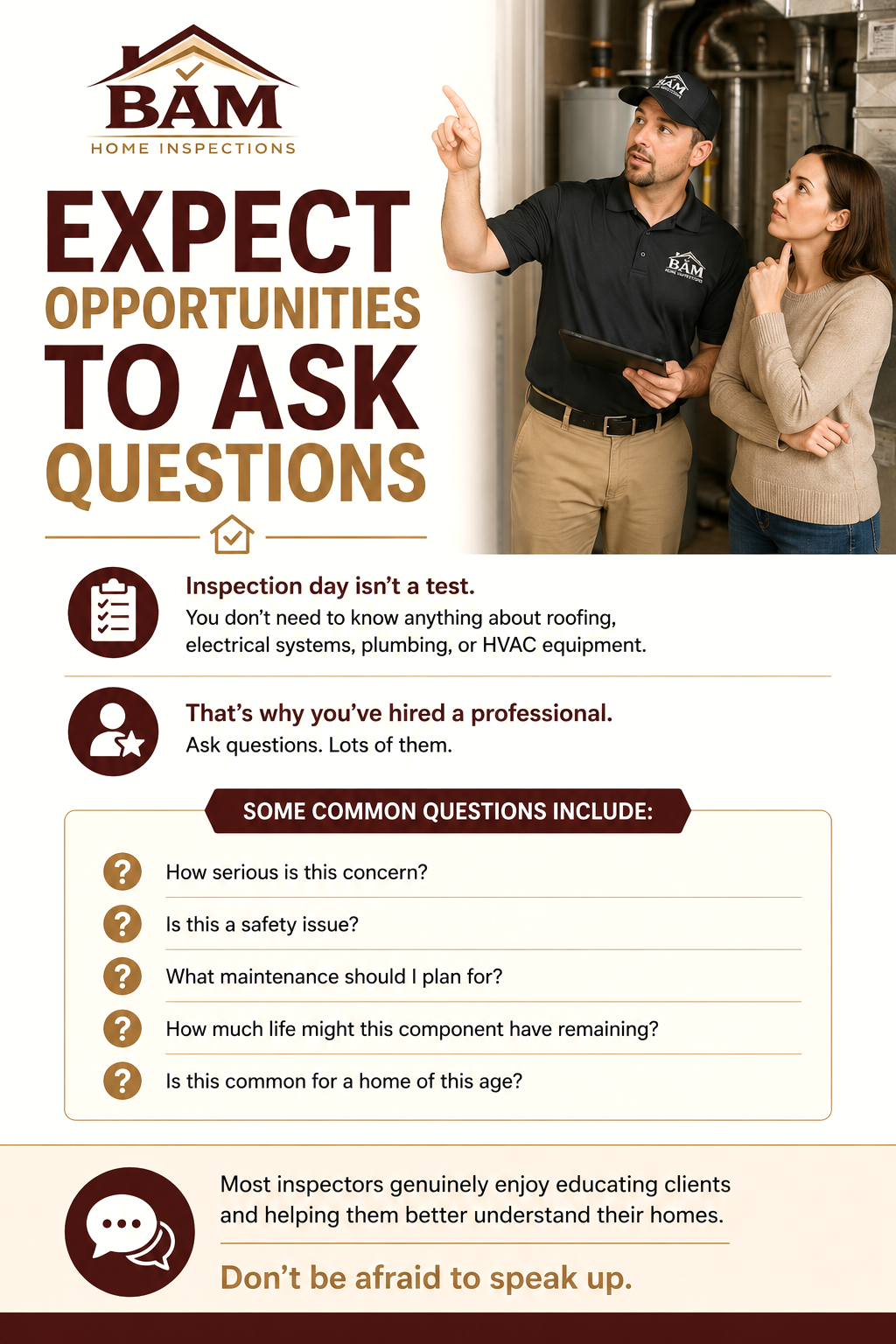
Inspection day isn’t a test.
You don’t need to know anything about roofing, electrical systems, plumbing, or HVAC equipment.
That’s why you’ve hired a professional.
Ask questions.
Lots of them.
Some common questions include:
- How serious is this concern?
- Is this a safety issue?
- What maintenance should I plan for?
- How much life might this component have remaining?
- Is this common for a home of this age?
Most inspectors genuinely enjoy educating clients and helping them better understand their homes.
Don’t be afraid to speak up.
Most inspectors genuinely enjoy educating clients and helping them better understand their homes. Don't be afraid to speak up. [What to Expect on Inspection Day]
BAM Home Inspections Share to X
Expect a Walkthrough Near the End
One of the most valuable parts of inspection day often happens near the conclusion of the inspection.
Once the inspector has completed the evaluation, they will typically walk you through the most significant findings and answer any questions you may have.
This discussion helps place the findings into context.
Rather than focusing on dozens of individual observations, you’ll gain a clearer understanding of:
- Safety concerns
- Major concerns
- Recommended repairs
- Maintenance priorities
- Areas that may warrant further evaluation
This conversation often helps buyers leave feeling much more confident about the home and their next steps.
Once the inspector has completed the evaluation, they will typically walk you through the most significant findings and answer any questions you may have. This discussion helps place the findings into context. [What to Expect on Inspection Day]
BAM Home Inspections Share to X
Pro Tip: Save Most Questions for the Walkthrough
While you’re welcome to ask questions throughout the inspection, many buyers find it helpful to save detailed discussions for the walkthrough near the end.
By then, the inspector has evaluated the entire property and can discuss findings within the broader context of the home’s overall condition.
Expect Clarity, Not Fear
Home inspections sometimes get an unfair reputation.
Some buyers worry that inspectors are looking for reasons to kill the deal.
That’s not the goal.
A quality home inspection is not about creating fear.
It’s not about finding reasons not to buy the home.
It’s about providing information.
The purpose of the inspection is to help you better understand:
- The home’s condition
- Potential safety concerns
- Significant defects
- Maintenance needs
- Future planning considerations
The more you understand about the home, the more confident you’ll feel in your decisions.
What Should You Bring to the Inspection?
A few simple things can help you get the most from the experience:
Inspection Day Checklist
✓ Questions you want answered
✓ Comfortable shoes
✓ A bottle of water
✓ A positive attitude
✓ A willingness to learn
Most importantly, bring curiosity.
You don’t need a toolbox or construction experience.
Inspection day is one of the best opportunities you’ll have to learn about the home before it becomes yours.
Final Thoughts
Inspection day doesn’t have to be intimidating.
In fact, many buyers discover that it’s one of the most valuable and educational parts of the entire home-buying process.
You’ll learn how the home works.
You’ll gain insight into its condition.
And you’ll leave with a clearer understanding of what to expect as a homeowner.
Remember:
The goal isn’t to find a perfect house.
The goal is to understand the house you’re buying.
And when you understand the home, you can move forward with greater clarity, confidence, and peace of mind.
Frequently Asked Questions (FAQs)
Most home inspections take between two and four hours, depending on the size, age, and condition of the home. Larger homes, older properties, or homes with additional services such as sewer scope inspections or radon testing may take longer. A thorough inspection should never feel rushed.
Yes. While attendance is not required, buyers are strongly encouraged to attend at least part of the inspection. Inspection day provides an excellent opportunity to learn about the home’s systems, maintenance requirements, and overall condition. Many buyers find the walkthrough at the end of the inspection especially valuable.
Not at all. Every home has findings, including newer homes and well-maintained properties. The purpose of the inspection is not to determine whether a home is perfect—it’s to help buyers understand the condition of the property and make informed decisions. Most inspection reports contain a mix of maintenance items, aging components, and recommendations for future improvements.
Some of the most helpful questions include:
- Is this a safety concern?
- How serious is this issue?
- What maintenance should I plan for?
- Is this common for a home of this age?
- How much life might this component have remaining?
A good inspector welcomes questions and enjoys helping buyers better understand the home.
After the inspection, you’ll typically receive a detailed report outlining the inspector’s observations, findings, photographs, and recommendations. Many inspectors also conduct a walkthrough to review significant concerns, maintenance priorities, and next steps. This helps buyers understand which findings are routine and which may require further attention or negotiation.
You don’t need any special tools or construction knowledge. Bring a list of questions, comfortable shoes, a bottle of water, and a willingness to learn. Inspection day is one of the best opportunities you’ll have to learn how the home works before it becomes your responsibility as a homeowner.