
Water Testing in Colorado
Know what’s in your water—before it’s yours.
Professional water testing helps identify potential contaminants and provides clear insight—so you can make confident decisions before you buy or move in.
looking for something specific?
click for your question -->
+ What is Water Testing for a Home?
+ Do I Need Water Testing When Buying a Home?
+ Why is Water Testing Important for a Home?
+ Is Water Testing Important in Colorado?
+ What are Some Fast Facts About Water Testing?
+ Water Testing in Colorado
+ What Sets BAM Home Inspections Apart?
+ What Additional Services are Available?
+ FAQs
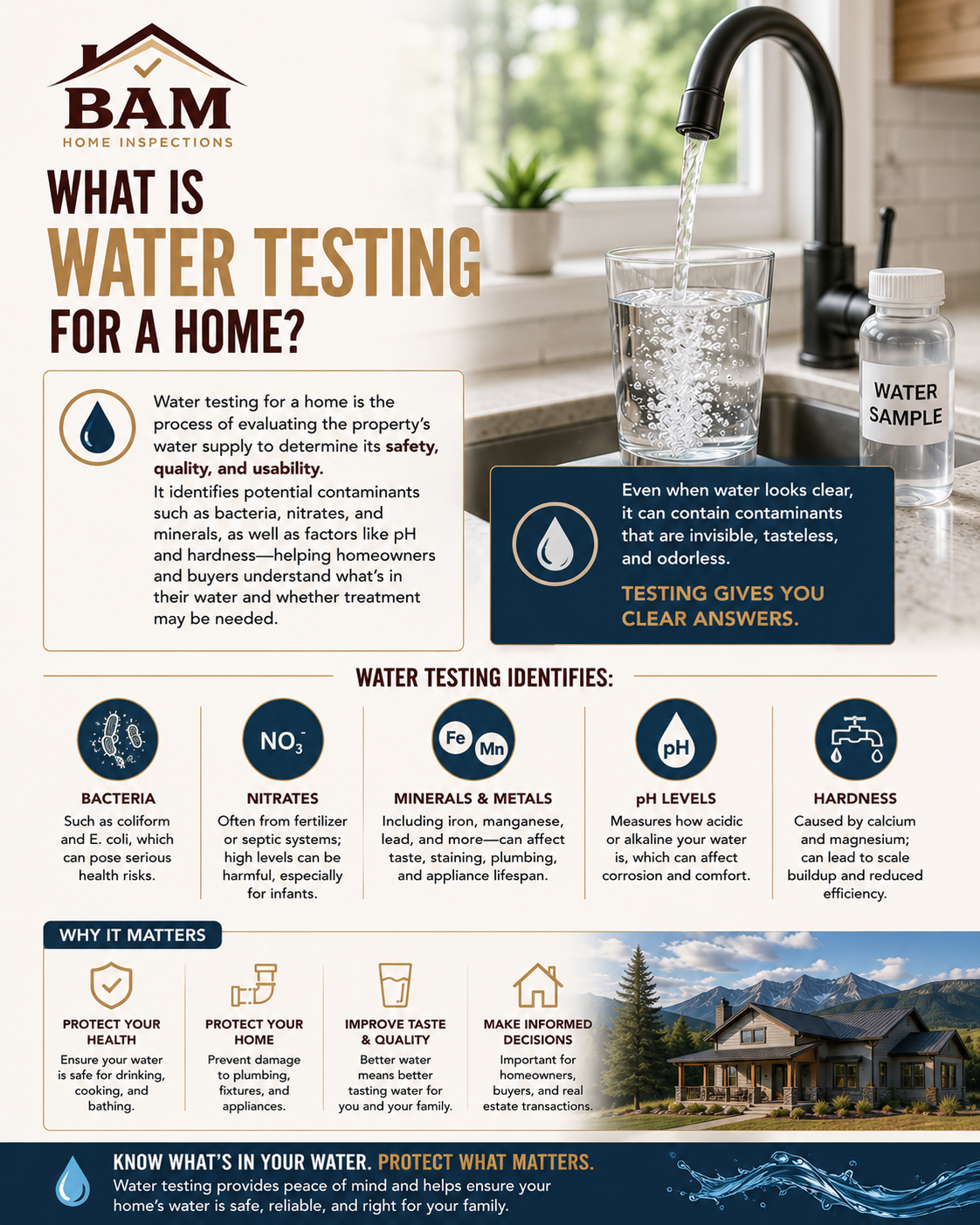
What Is Water Testing for a Home?
Water testing for a home is the process of evaluating the property’s water supply to help determine its safety, quality, and overall usability. The testing process is designed to identify potential contaminants and water quality characteristics that may impact health, plumbing systems, appliances, taste, odor, or everyday use. Depending on the testing package selected, water testing may evaluate for:
- Bacteria, including total coliform and E. coli, which may indicate contamination and possible health concerns
- Nitrates and nitrites, which can sometimes enter groundwater from fertilizers, septic systems, or environmental sources
- Minerals, such as iron, manganese, and hardness levels, which can contribute to staining, buildup, unpleasant taste, or reduced appliance efficiency
- Additional contaminants, such lead
One of the most important things homeowners and buyers should understand is that water quality issues are often impossible to detect without testing. Water may appear crystal clear and still contain contaminants that are invisible, odorless, and tasteless.
Do I Need Water Testing When Buying a Home?
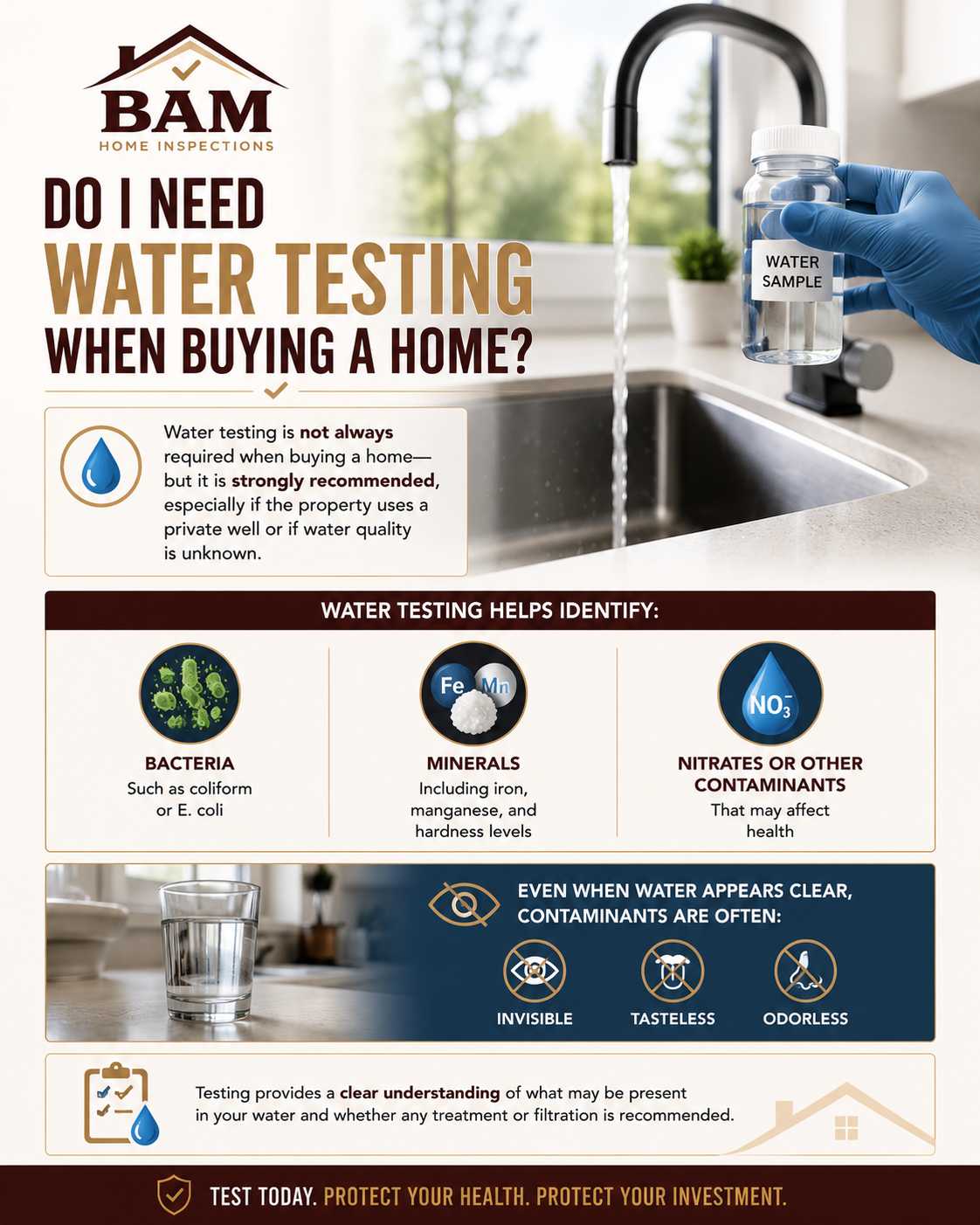
Water testing is not always required during a home purchase—but it is recommended, particularly when a property is served by a private well, has an unknown water history, or when there are concerns about water quality, taste, odor, or staining.
Water testing can help identify a range of potential concerns, including:
- Bacteria, such as total coliform and E. coli, which may indicate contamination and possible health risks
- Minerals, including iron, manganese, and hardness levels, which can affect water taste, odor, staining, appliance performance, and plumbing systems
- Nitrates and other contaminants, which may be present from agricultural runoff, septic systems, or environmental conditions and may impact health—especially for infants and vulnerable individuals
- Additional water quality concerns, depending on the property, location, and testing package selected
For homes with private wells, testing is especially important because the water supply is not regulated or routinely monitored in the same way as municipal water systems. Even municipal water can sometimes benefit from additional testing if there are concerns about aging plumbing, sediment, taste, odor, or localized water conditions.
Why Is Water Testing Important for a Home?
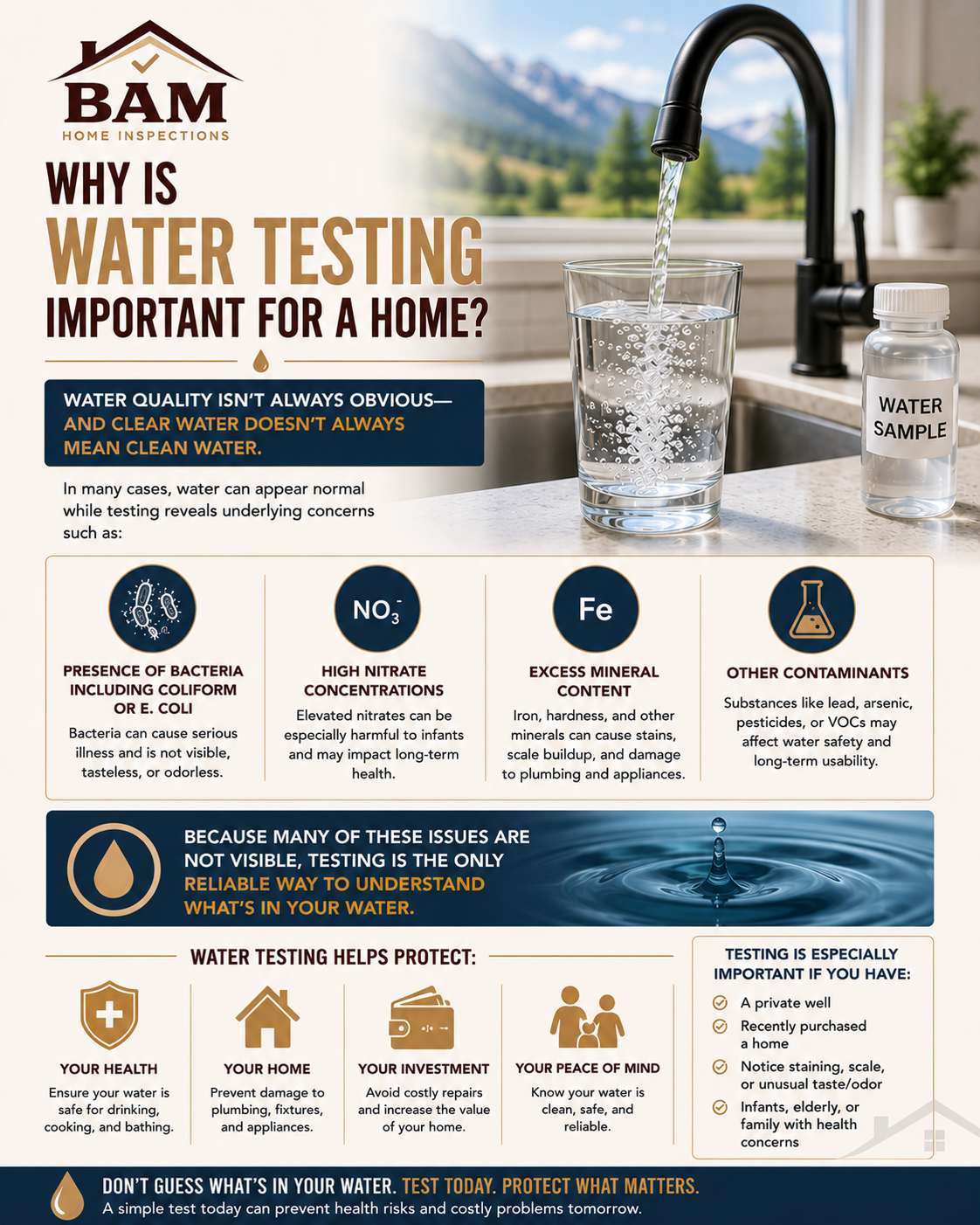
Water quality isn’t always obvious—and clear water doesn’t always mean clean water. In many cases, water can appear normal in color, taste, and odor while testing reveals underlying concerns that may affect health, plumbing systems, appliances, and long-term water usability.
Water testing can help identify issues such as:
- Bacteria, including total coliform and E. coli, which may indicate contamination and potential health concerns
- Elevated nitrate levels, which can enter groundwater through environmental or agricultural sources and may impact health
- Excess minerals, such as iron, manganese, or hard water, which can contribute to staining, buildup, appliance wear, and plumbing inefficiencies
- Other potential contaminants that may affect the overall safety, quality, taste, or long-term performance of the water supply
One of the biggest challenges with water quality concerns is that many are invisible, odorless, and tasteless. Even water that looks perfectly clean may contain contaminants that cannot be detected without proper testing. That’s why water testing is the most reliable way to understand what’s in the water and whether treatment, filtration, or further evaluation may be recommended.
Is Water Testing Important In Colorado?
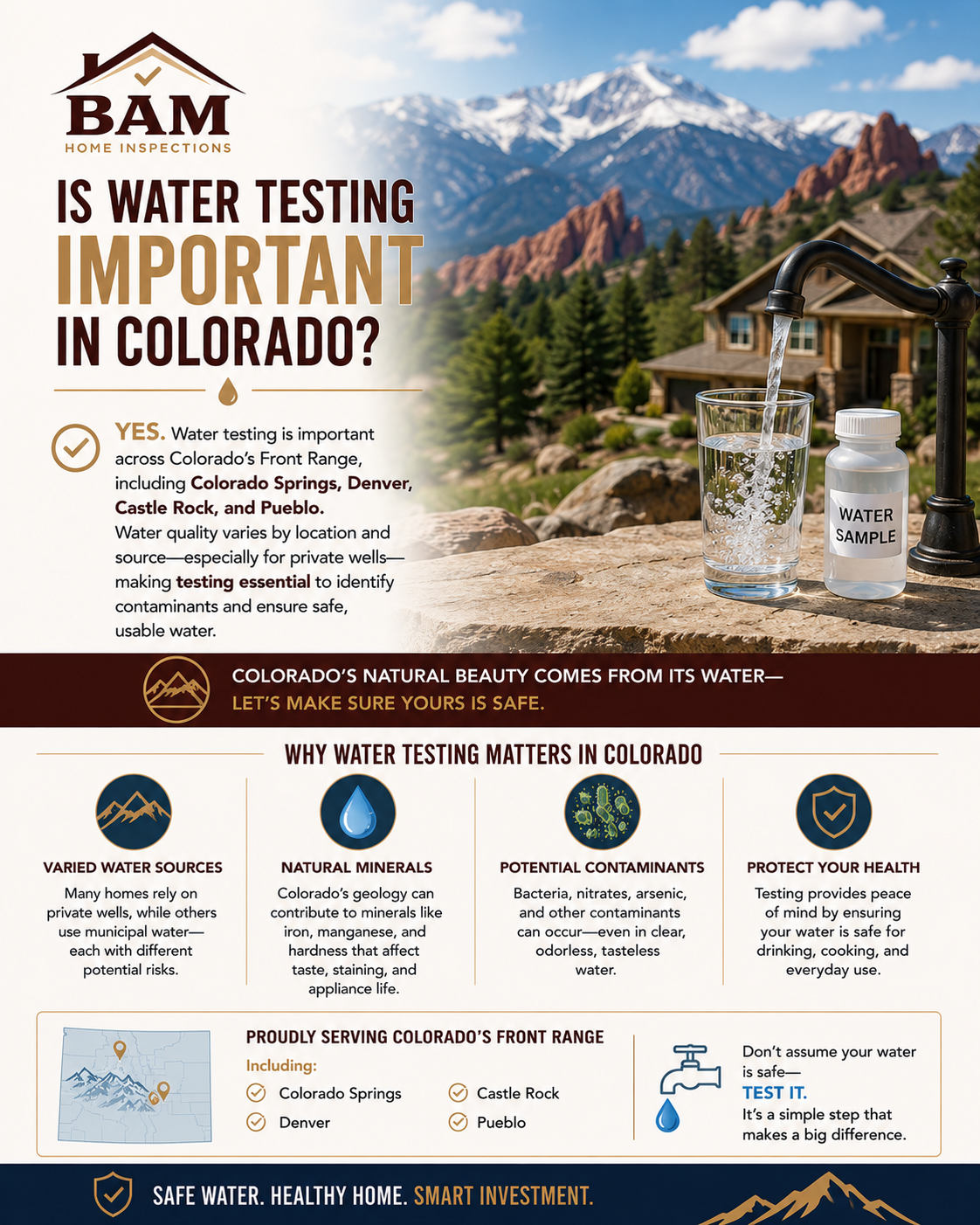
Yes—water testing is highly recommended throughout Colorado, including Colorado Springs, Monument, Castle Rock, Denver, Pueblo, Woodland Park, Peyton, Fountain, and communities across the Front Range. Water quality can vary significantly depending on the property’s location, water source, plumbing system, surrounding environmental conditions, and whether the home is connected to a municipal supply or private well.
For homes served by private wells, water testing is especially important because well water is not routinely monitored or regulated in the same way as municipal water systems. Groundwater quality can change over time and may be influenced by factors such as:
- Naturally occurring minerals commonly found in Colorado soils and groundwater, including iron, manganese, and hard water minerals
- Bacteria, including total coliform or E. coli, which may indicate contamination concerns
- Nitrates or other environmental contaminants, which can enter groundwater from agricultural activity, septic systems, or surrounding land use
- Changes in water quality over time due to weather, drought conditions, flooding, nearby development, or aging well components
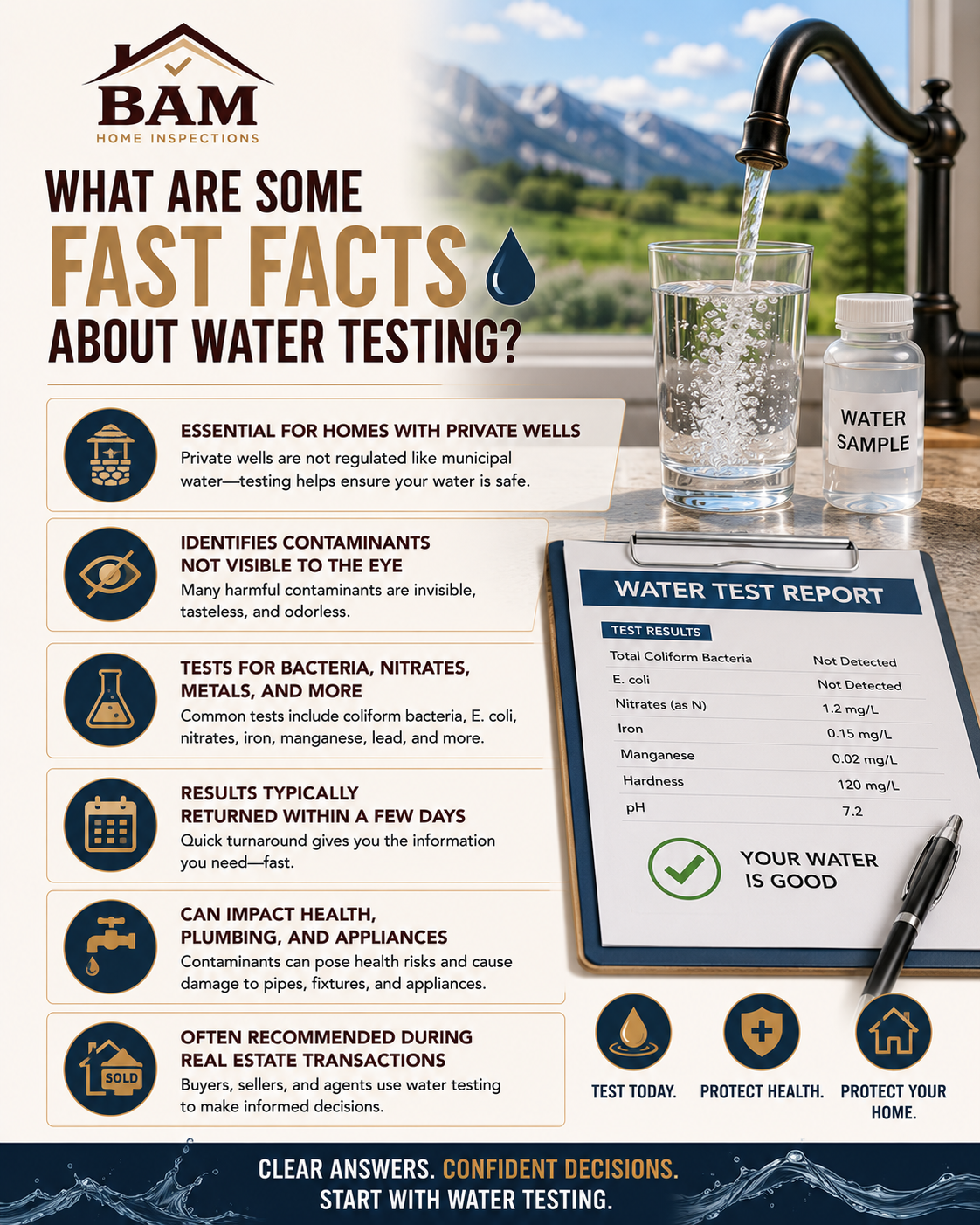
What Are Some Fast Facts About Water Testing?
💧 Essential for Homes with Private Wells. Private well water is not routinely monitored like municipal water systems, making testing one of the best ways to evaluate safety and water quality.
🔬 Identifies Contaminants You Can’t See. Many water concerns are invisible, odorless, and tasteless. Clear water does not always mean clean water.
🦠 Tests for Bacteria, Nitrates, Minerals & More. Water testing may identify concerns such as coliform bacteria, E. coli, nitrates, iron, manganese, hardness levels, and other potential contaminants.
⏱️ Results Typically Returned Within a Few Days. Most laboratory testing results are available quickly, helping buyers and homeowners make informed decisions without unnecessary delays.
🏠 Can Impact Health, Plumbing & Appliances. Water quality concerns may affect drinking safety, plumbing performance, fixture staining, water heaters, dishwashers, and long-term appliance lifespan.
📋 Frequently Recommended During Real Estate Transactions. Water testing helps buyers better understand the home’s water quality before closing—especially when the water source or history is unknown.
📍 Water Quality Varies by Location Across Colorado. Water conditions can differ significantly throughout Colorado Springs, Monument, Castle Rock, Denver, Pueblo, and surrounding Front Range communities.
Water Testing in Colorado
Proudly serving Colorado Springs and surrounding communities, including Monument, Fountain, Peyton, and Woodland Park—along with the greater Front Range, including Castle Rock, Denver, and Pueblo.
We understand the risks of poor water quality and offer testing to screen for nitrates, nitrites, coliform, E. coli, excess minerals, and lead to verify your water is safe.


What additional services are available?
A sewer scope is most valuable when combined with a full home inspection.
Also consider:
Radon Testing
Radon is an odorless, colorless, and naturally occurring radioactive gas that can cause serious health issues over time.
Sewer Scope Inspection
A sewer scope inspection uses a small camera to assess your sewer line quickly. By analyzing the pipes from the inside, an inspector can identify any issues early to prevent costly repairs.
Wood-Destroying Organism Inspection
Our WDO inspection includes a detailed examination of the home looking for signs of wood destroying organisms to include termites, carpenter ants, carpenter beetles, and wood-boring beetles. Fulfills most VA Loan requirements.
FAQs
A water test checks for the presence of contaminants, mineral levels, and overall water quality to determine if the water is safe and suitable for everyday use.
Depending on the source and testing package, water testing may evaluate:
- Bacteria, such as total coliform and E. coli
- Nitrates and nitrites, which can impact health—especially in well water
- Mineral content, including iron, manganese, and hardness levels
- Other contaminants, such as lead or additional substances depending on local conditions
Because many water quality issues are invisible, tasteless, and odorless, testing provides a clear understanding of what may be present.
No, water testing is not required for all homes in Colorado. Homes connected to municipal water systems in areas like Colorado Springs, Denver, Castle Rock, and Pueblo are typically not required to have water testing as part of a standard real estate transaction.
For homes using private wells, water testing is more commonly required—especially for certain loan types such as VA or FHA financing. In these cases, testing may be needed to confirm the water meets basic safety standards.
The cost of water testing typically ranges from a few hundred dollars, depending on the scope and type of testing performed.
Pricing can vary based on:
- Number of contaminants tested (basic vs. expanded panels)
- Laboratory analysis and reporting requirements
- Any additional sampling or specialized testing requested
While costs can vary, water testing is a relatively small investment compared to the value of understanding your water quality.
Water testing results are typically available within 24 hours after laboratory analysis is completed. Turnaround time can vary depending on the type of test performed, but most laboratories process standard water tests within 2 to 5 business days. Lead tests could take up to two weeks to receive results.
Timing may be influenced by:
- Type of analysis (basic screening vs. expanded testing panels)
- Laboratory processing time and workload
- Specific contaminants being tested (some require longer analysis)
Once results are received, they are provided in a clear, easy-to-understand format, along with guidance to help you interpret what the findings mean and whether any next steps may be appropriate.
Yes. Water can look clean, clear, and even taste normal—but still contain contaminants that make it unsafe.
Even in homes where the water appears normal, testing may reveal:
- Bacteria, including coliform or E. coli
- Nitrates or other contaminants that may impact health
- Mineral content, such as iron or hardness, that can affect plumbing and fixtures
Because these issues are often undetectable without testing, appearance alone is not a reliable indicator of water quality.
If contaminants are found in your water, the next step is to understand the results and determine the appropriate solution based on the type and level of contamination. Not all findings require the same response. Some may be minor and manageable, while others may need prompt attention to protect health and the home.
The process typically includes:
- Reviewing the test results to understand what contaminants are present and at what levels
- Consulting with a qualified professional, such as a water treatment specialist, if needed
- Identifying appropriate treatment options, such as filtration, disinfection, or system adjustments
- Addressing the source of the issue, when possible (for example, well conditions or plumbing-related factors)
Private well water should typically be tested at least once per year, as well as during a home purchase, to ensure it remains safe and suitable for use. Unlike municipal water systems, private wells are not regulated, which means ongoing water quality is the homeowner’s responsibility.
Routine and situational testing is recommended to:
- Monitor for bacteria, such as coliform or E. coli
- Check for nitrates and other contaminants that may impact health
- Evaluate mineral content, including iron, manganese, and hardness
- Ensure overall water quality remains consistent and safe
Regular water testing is a simple and effective way to protect your health, your home, and your water supply over time.
Yes. Mineral content and contaminants in water can affect pipes, fixtures, and appliances over time—impacting both performance and longevity. Hard water and dissolved minerals such as calcium, magnesium, iron, and manganese can lead to scale buildup inside plumbing and appliances. Over time, this buildup may reduce efficiency, restrict water flow, and contribute to premature wear.
Certain contaminants and water conditions can also:
- Contribute to corrosion in pipes and fixtures, especially with unbalanced pH
- Cause staining or buildup on sinks, tubs, and water-using appliances
- Reduce the efficiency and lifespan of systems such as water heaters, dishwashers, and washing machines
- Increase maintenance and repair needs over time
Routine water testing helps identify these conditions early—allowing you to take steps that can protect your plumbing, extend the life of your appliances, and reduce long-term costs.
Yes. Water testing is worth it because it helps you understand the safety and quality of your home’s water—something that isn’t always visible.
Water testing provides value by:
- Identifying hidden contaminants that cannot be seen, tasted, or smelled
- Helping protect your health by detecting bacteria or harmful substances
- Preventing potential damage to plumbing and appliances caused by mineral content or corrosive water
- Giving you clear, actionable information before buying or moving into a home
Compared to the cost of unexpected repairs, water treatment systems, or potential health concerns, water testing is a relatively small investment.